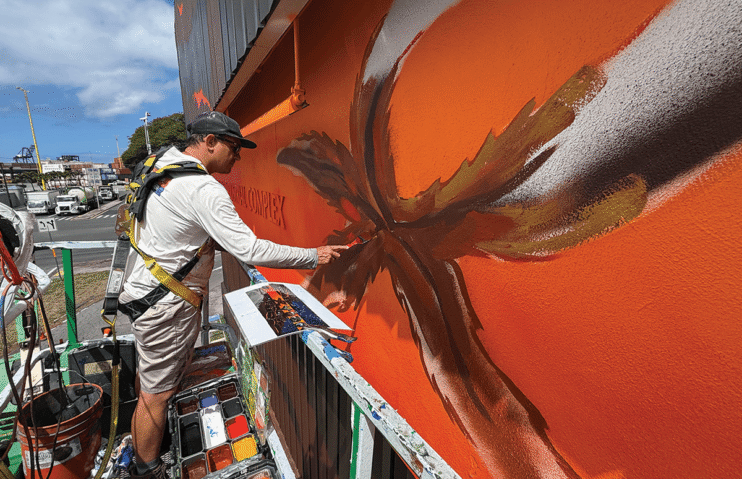
This summer, two large-scale murals transformed prominent urban spaces into opportunities for transforming everyday spaces into opportunities for learning and reflection. Through collaborations with Greenpeace USA and Grow Good Hawaiʻi, these pieces explore how Native Hawaiian perspectives on land, ocean and stewardship, advancing Kapālama Kai’s vision as a place where culture, community and commerce come together.
For muralist Kaiʻili Kaulukukui, the artworks serve as an invitation to learn.
“Public art has a way of meeting people where they are,” he said. “My hope is that this mural sparks curiosity and encourages people to learn more.”
While each mural tells a distinct story, both are rooted in a shared understanding: people are inseparable from ʻāina. Together, the pieces titled, “Re-imagining Wao Kanaka” and “Kumulipo,” encourage viewers to reflect on their relationships with ʻāina and the kuleana that comes with those connections.
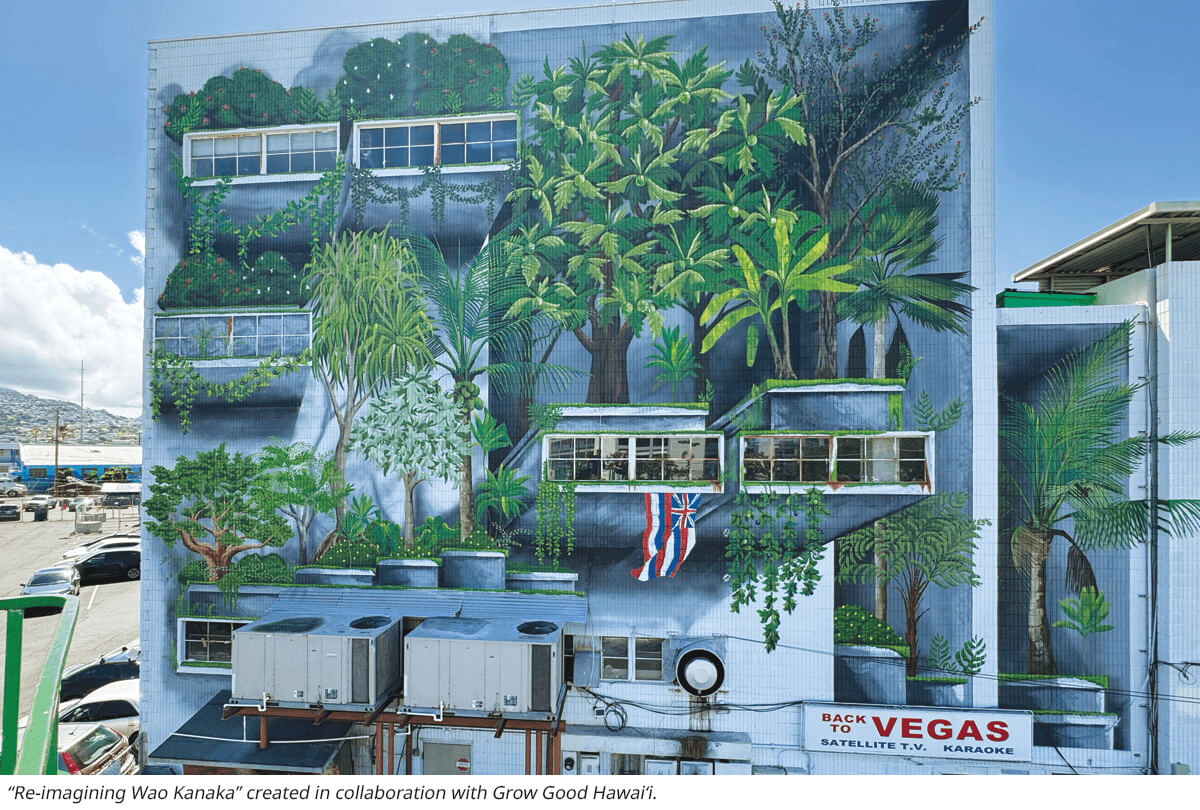
“Re-imagining Wao Kanaka,” created in collaboration with Grow Good Hawaiʻi, imagines a future where native plants, food systems and thriving ecosystems are woven into the urban landscape. Inspired by Native Hawaiian stewardship approach and the interconnected principles of the ahupuaʻa system, the mural reflects efforts to strengthen food security and restore natural systems through urban principles.
The roughly 3,000-square-foot mural features a diverse range of Native Hawaiian plants including ʻōhiʻa lehua, maiʻa, koaiʻa, ʻulu, niu, kukui, kalo and hāpuʻu, many of which are deeply connected to Kapālama. The project was completed over three weeks.
Its imagery invites viewers to envision what is possible when cities are designed not in opposition to nature, but in partnership with it. Through vibrant depictions of Native Hawaiian plant life and ecological abundance, the mural offers a vision of an urban forest fully realized, where community well-being and environmental health flourish together.
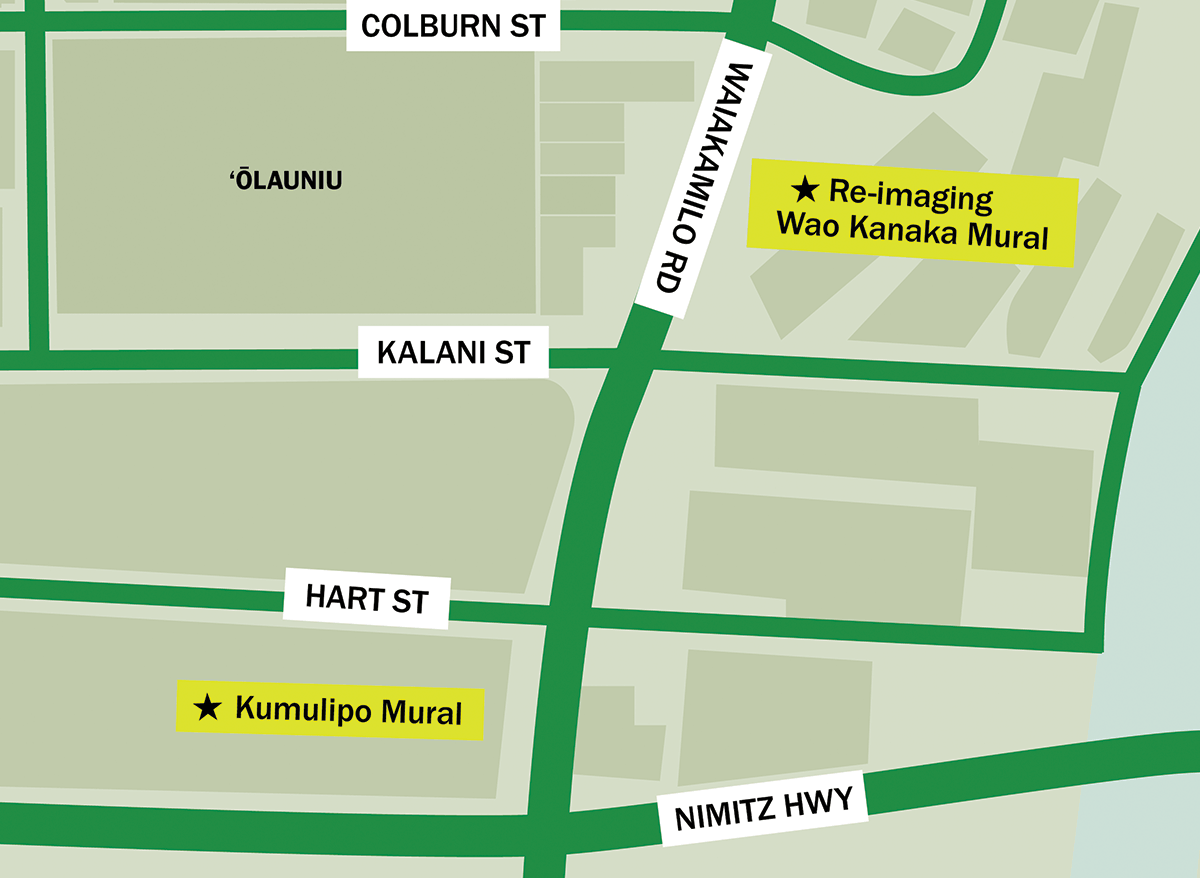
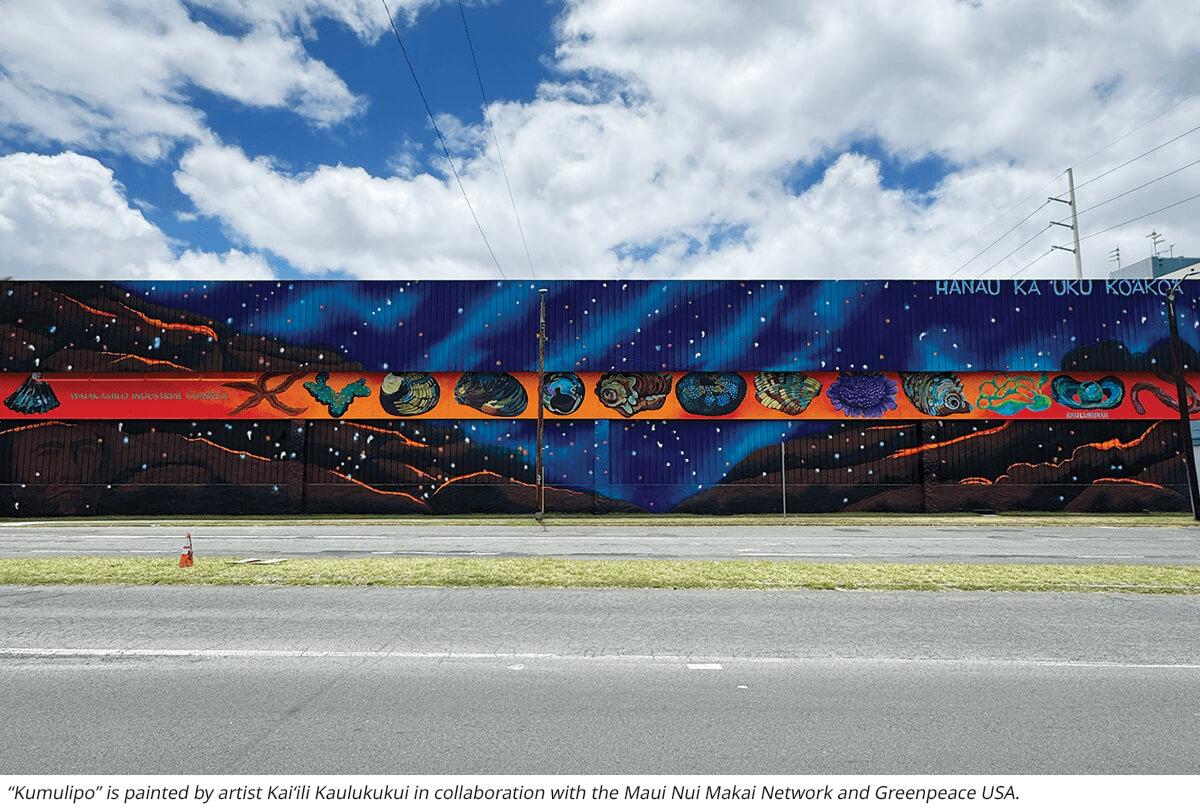
Across the Kalihi Kai fire station, the 6,500-square-foot mural, entitled “Kumulipo” It illustrates koʻa, limpets, and early ocean creatures, and invites viewers to look beyond the shoreline and consider a deeper connection.
Created with support from Greenpeace USA, the mural draws inspiration from the Kumulipo, a Hawaiian creation chant. Spanning 2,102 lines, the Kumulipo has been transmitted orally from generation to generation, revealing the genealogical connection of Hawaiians to ʻāina, as well as all forms of life. The cultural implication is the kuleana to care for all life forms, as they are our older siblings. The mural depicts the very beginnings of that legacy in visual form.
That message is central to the mural’s purpose.
“The Kumulipo describes everything created in the vertical water column of the deep sea up to the nearshore reefs, onto the land, into the hills, and even taking flight,” said Solomon Pili Kahoʻohalahala, a cultural practitioner and international ocean advocate. “When we do come into this honua, we have an inherent responsibility to be part of it and therefore, our kuleana is to care for nature.”
Through imagery inspired by the deep ocean and the earliest forms of life, Kumulipo encourages viewers to consider both ancestral knowledge and contemporary stewardship. It illustrates a worldview in which caring for the environment is not separate from caring for ourselves and future generations.
“There is this idea of caring and receiving,” Kahoʻohalahala said. “If we care for the environment and for all things in nature of which we belong, then we, too, will be cared for.”
“If someone sees the mural and becomes curious about the Kumulipo, or thinks differently about their relationship to the ocean, then the artwork is doing what it was meant to do,” said Bobbie Lau, senior asset manager with Ke Kula ʻo Kamehameha ʻĀina Pauahi Group.
Together, the murals advance a broader vision for Kapālama Kai as a cultural destination where learning, creativity and community intersect. They demonstrate how public art can activate space while amplifying Native Hawaiian values, environmental awareness and a deeper sense of connection to place.
“To have this mural on ʻāina Pauahi in Kapālama Kai is meaningful,” said Hilarie Alomar, director of planning and development with Ke Kula ʻo Kamehameha ʻĀina Pauahi Group. “This is a place where culture, community and commerce all meet.”
More than public art, “Re-imagining Wao Kanaka” and “Kumulipo” reflect the ongoing transformation of Kapālama Kai into a place where stories are shared, relationships are strengthened and culture thrives in the everyday experience of the community.
Community members can continue exploring the murals and see the artwork come to life by following @KapalamaKai on Instagram and Facebook.